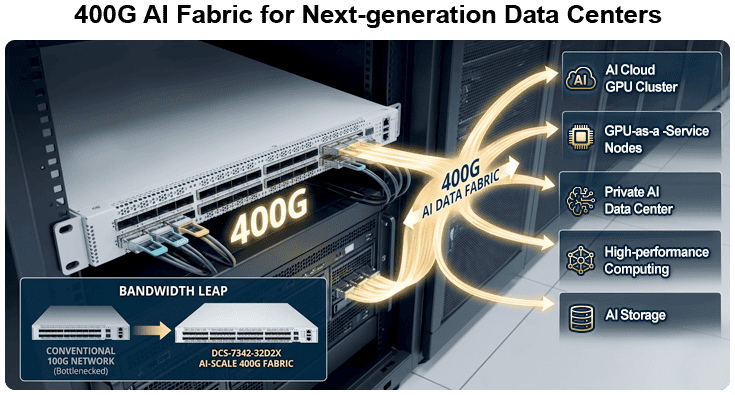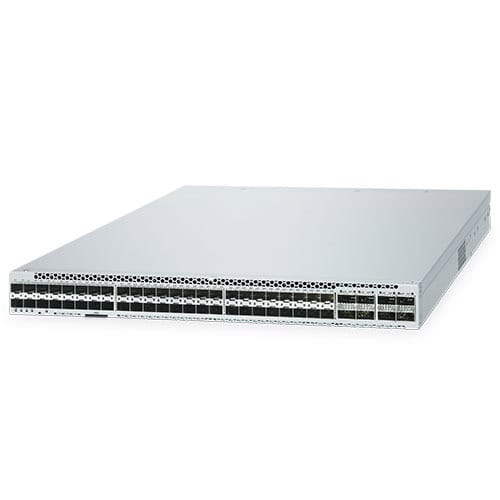


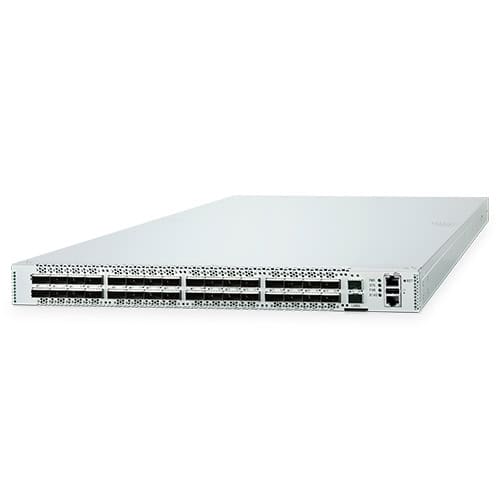
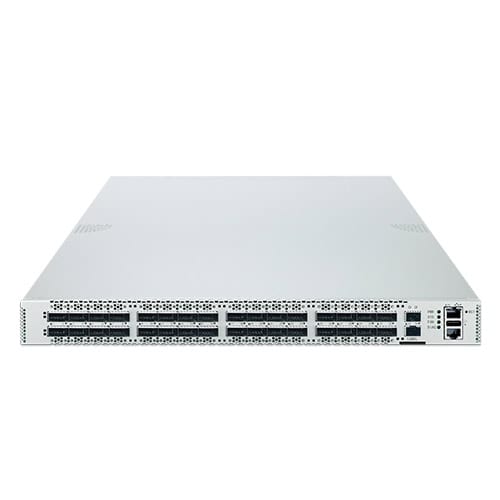
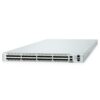
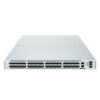
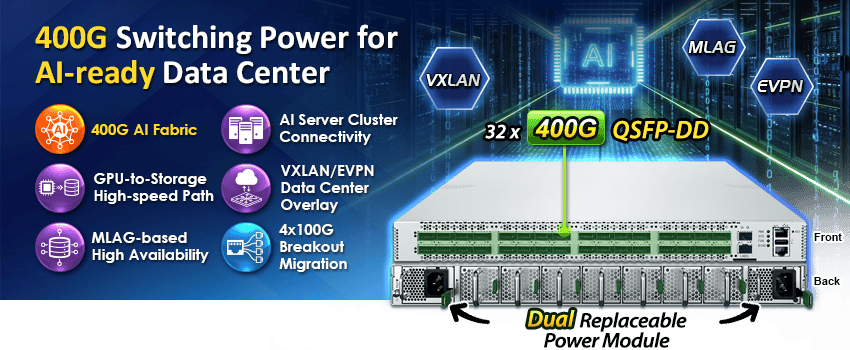
PLANET is proud to introduce the DCS-7342-32D2X, a Layer 3 32-port 400G QSFP-DD and 2-port 10G SFP+ Managed AI Data Center Switch designed for next-generation data center fabrics where AI servers, GPU clusters, high-speed storage and East-West traffic require massive bandwidth.
Unlike a conventional cloud data center switch that primarily expands the server aggregation backbone, the DCS-7342-32D2X is positioned for AI-scale infrastructure. It provides a high-density 400G switching foundation for AI training, distributed inference, GPU-to-GPU communication, AI storage fabrics, high-performance computing, and 400G spine-leaf architectures.
With 32 x 400G QSFP-DD interfaces, advanced Layer 3 routing, VxLAN/EVPN virtualization, MLAG redundancy, ECMP load balancing, BGP/OSPF/IS-IS routing and carrier-grade management, the DCS-7342-32D2X helps organizations transition from cloud networking to AI-ready data center fabric without requiring an open system NOS such as SONiC.
For environments migrating from existing 100G infrastructure, the 400G QSFP-DD design can also support flexible 400G-to-4 x 100G breakout deployment models, enabling native 400G AI servers and 100G leaf/server connections to coexist in a phased upgrade architecture.
Future-ready AI Data Center Interconnects: Advanced L3 Routing & Virtualization
The DCS-7342-32D2X is a high-performance Layer 3 data center switch engineered for AI-driven, high-speed and scalable environments. With a high-density configuration of 32 x 400G QSFP-DD ports, it serves as a foundation for AI fabric spine, 400G aggregation, high-performance computing and next-generation data center deployments.
- Massive Routing Capacity: optimized to support large-scale IPv4/IPv6 routing tables, facilitating expansive topologies and intensive control-plane workloads. Final entry count must be verified.
- Advanced Dynamic Routing: supports IPv4/IPv6 routing protocols including OSPFv2/v3, BGP4/BGP4+ and IS-IS for scalable inter-subnet communication.
- Next-generation Data Center Overlays: VxLAN and EVPN enable flexible, multi-tenant virtualized overlay networks for AI/cloud fabric deployment.
- Carrier-grade Resilience: BFD, ERPS, VRRP and MLAG enhance service continuity and reduce single points of failure across mission-critical fabrics.
- Intelligent Traffic Management: ECMP, PBR, QoS and multicast routing help optimize bandwidth utilization across GPU clusters, storage fabrics and data center services.
- Robust Security Infrastructure: TACACS+, RADIUS, SSH, 802.1X, ACL and control-plane protection help safeguard critical data center management and traffic paths.
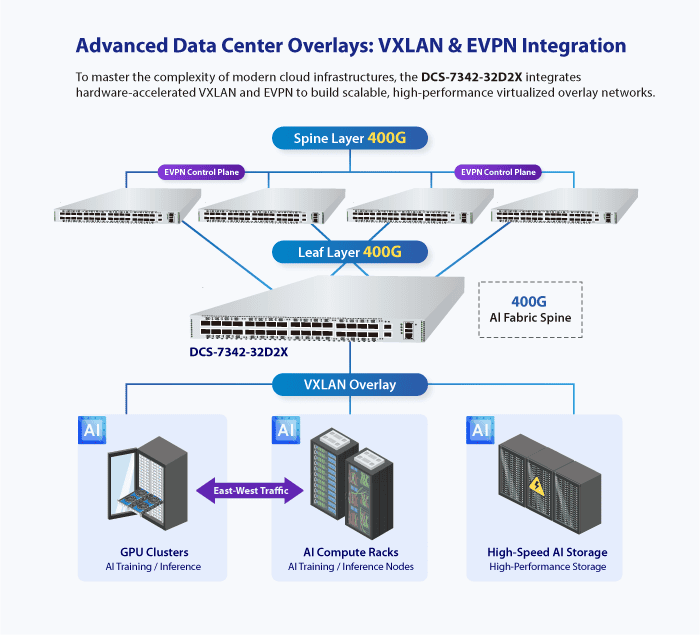
Advanced Data Center Overlays: VxLAN & EVPN Integration
To master the complexity of modern cloud infrastructures, the DCS-7342-32D2X integrates hardware-accelerated VxLAN and EVPN to build scalable, high-performance virtualized overlay networks.
- Efficient Virtualization: VxLAN encapsulates L2 frames into L3 UDP packets, supporting up to 16 million isolated logical networks across a physical IP fabric.
- BGP-Driven Control Plane: Leveraging EVPN with BGP, the system intelligently distributes reachability info to minimize broadcast flooding and optimize traffic.
- Seamless Workload Mobility: Maintains L2 connectivity during VM or container migration across physical hosts, ensuring uninterrupted service delivery.
- Optimized Routing: Supports Integrated Routing and Bridging (IRB) and advanced multicast (PIM-SM/SSM) for efficient inter-segment traffic flow.
- Secure Multi-Tenancy: Features VFI (Virtual Forwarding Instance) to provide isolated, secure environments for multiple tenants over a shared infrastructure.
- Wire-Speed Hardware: The architecture handles all encapsulation at wire-speed, delivering ultra-low-latency forwarding for high-throughput applications.
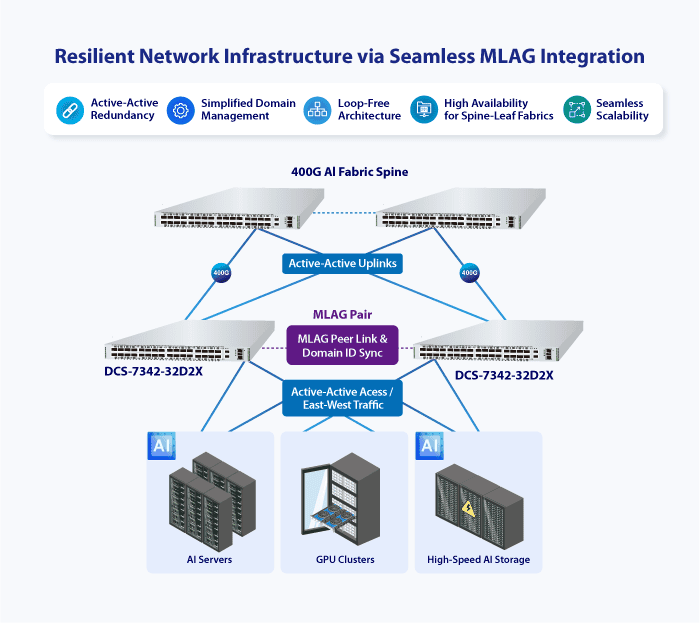
Resilient Network Infrastructure via Seamless MLAG Integration
To ensure non-stop network services and maximize bandwidth utilization, the DCS-7342-32D2X supports advanced MLAG (Multi-Chassis Link Aggregation). This technology delivers carrier-grade reliability and architectural flexibility for mission-critical infrastructures.
- Active-Active Redundancy: MLAG allows two switches to function as a single logical entity, enabling active-active link aggregation for seamless traffic failover.
- Simplified Domain Management: Administrators can easily configure and identify the MLAG cluster through the Domain ID setting, ensuring synchronized and stable control-plane operations.
- Loop-Free Architecture: By leveraging MLAG with LACP, the network eliminates the need for Spanning Tree Protocol (STP) on access links, resulting in higher bandwidth efficiency and near-instant convergence.
- High Availability for Spine-Leaf Fabrics: MLAG enhances resilience at the leaf layer, providing redundant paths to ensure that a single chassis failure never interrupts data flow.
- Seamless Scalability: The combination of MLAG and hardware-based load balancing allows for linear bandwidth scaling as your data center infrastructure grows.
Carrier-Grade Resilience for High-Scalability Network Environments
PLANET delivers a high-density, carrier-grade switching solution engineered to dominate the rigorous traffic demands of modern scalable networks. By integrating advanced Layer 3 software with next-generation hardware, this platform ensures seamless expansion and unwavering stability.
- Scalable Layer 3 Routing Infrastructure: Supports a comprehensive suite of routing protocols, including BGP, OSPF, and IS-IS, allowing for flexible and efficient path selection across complex, large-scale architectures.
- Next-Generation Virtualization: Hardware-accelerated VxLAN and EVPN capabilities enable the creation of scalable virtualized overlay networks, significantly improving workload mobility for cloud and multi-tenant environments.
- Advanced Traffic Engineering & QoS: Granular QoS Class-Maps and Policy-Maps ensure peak performance for mission-critical applications, while ECMP (Equal-Cost Multi-Path) optimizes bandwidth utilization and load balancing.
- Carrier-Grade High Availability: Features BFD (Bidirectional Forwarding Detection) for sub-second fault detection, paired with ERPS (ITU-T G.8032) and MRPP to guarantee maximum uptime and rapid self-healing.
- Robust Security & Access Control: A multi-layered security framework—including TACACS+, RADIUS, 802.1X, and hardware-based Anti-ARP Scan—safeguards management access and data integrity.
Intelligent Management & Advanced Security Framework
The DCS-7342-32D2X combines sophisticated automation protocols with robust security architecture to simplify operations and protect critical data paths.
- Next-Gen Automation with NETCONF: Supports the NETCONF protocol to enable programmable network management and seamless integration with modern orchestration tools.
- Real-Time Traffic Analysis: Features sFlow technology for high-performance, hardware-based monitoring of network traffic, providing deep visibility into bandwidth usage and potential anomalies.
- Carrier-Grade AAA Security: Implements TACACS+, RADIUS, and SSH v2.0 to ensure encrypted management access and centralized authentication.
- Proactive Control-Plane Protection: Equipped with Anti-ARP Scan and hardware-based DDoS attack prevention to safeguard the switch CPU from malicious traffic.
- Precision Timing & Monitoring: Supports NTP for synchronized timekeeping and comprehensive RMON for proactive remote monitoring and diagnostics.
- Eco-Friendly Hardware Efficiency: Features intelligent fan temperature control that automatically adjusts speeds to reduce power consumption and noise.
Sustainable Infrastructure: Intelligent Power Management & Green Efficiency
As environmental responsibility becomes a core requirement for modern IT, the DCS-7342-32D2X integrates advanced power-saving technologies without compromising high-performance data center demands.
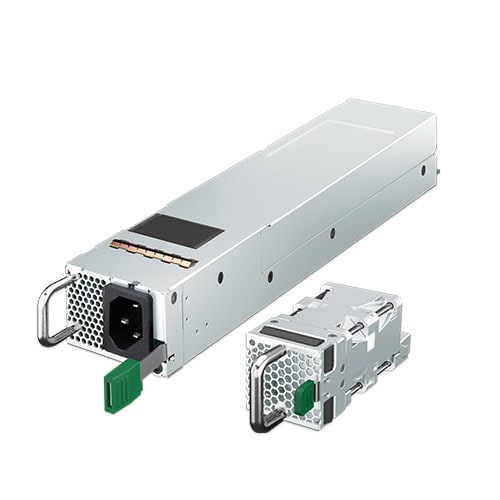
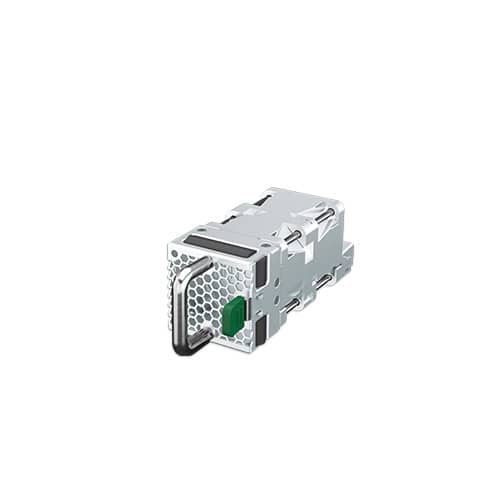
- Intelligent Fan Speed Control: Features a smart cooling architecture with redundant, hot-swappable fans. These fans dynamically adjust rotational speeds based on real-time temperature sensors, significantly reducing power consumption and acoustic noise during lower traffic periods.
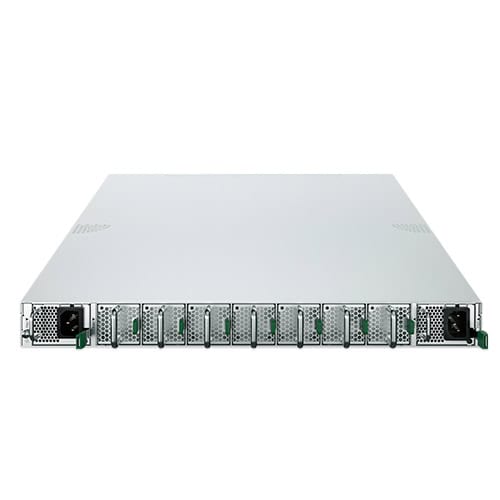
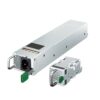
- High-Efficiency Redundant Power Supplies: Equipped with hot-swappable AC power modules. The redundant design not only ensures maximum uptime but also optimizes load sharing to achieve peak energy efficiency.
- Hardware-Level Power Scaling: The advanced chipset architecture is designed to scale power consumption based on port link status. Unused ports are automatically placed in a low-power state, lowering the overall energy footprint of the rack.
- Optimized Thermal Design: The chassis airflow is engineered for professional front-to-back cooling, contributing to better overall Data Center PUE by aligning with hot/cold aisle containment strategies.
- Sustainable OPEX Reduction: By combining intelligent energy management with high-density performance, the DCS-7342-32D2X helps organizations reduce Total Cost of Ownership (TCO) and meet corporate carbon reduction goals.
1-to-4 Port Expansion: 400G to 4 x 100G Breakout Solution
Maximize your hardware investment by transforming a single 400G QSFP-DD port into four independent 100G QSFP28 connections. This professional-grade breakout cable provides the most efficient way to link high-capacity core switches to multiple high-performance servers or storage nodes.
Core Advantages
- 1-to-4 Port Multiplying: Unlock 4 x 100Gbps lanes from a single 400G interface, significantly increasing available port count for downstream devices.
- Direct 400G Utilization: Fully utilize the massive 400Gbps bandwidth of your DCS-7342-32D2X without wasting unused capacity.
- Seamless Hardware Integration: Specifically engineered for 1-Port 400G/QSFP-DD modules, ensuring perfect synchronization across all four 100G lanes.
- Carrier-Grade Efficiency: Eliminates the need for multiple expensive 100G transceivers and complex patch panels, reducing both failure points and costs.
- Low-Latency Fabric: Direct-attach architecture ensures near-zero signal delay, ideal for high-frequency trading and cloud computing.
- Spine-Leaf Optimization: Connect one 400G Spine port directly to four 100G Leaf switches or servers, creating a highly scalable and cost-effective network fabric.